
What Ueno Bank teaches about forbearance, politics and Latin American bank risk
“Everybody knows the dice are loaded.”
— Leonard Cohen, “Everybody Knows”
At Cybiont Capital my partner and I cover U.S. banks. Ueno sits outside that coverage, so this is commentary rather than research, from someone who covered Latin American banks for years.
The reported solvency ratio was 13.85 percent. It was never really that.
The Reported Ratio Was Not an Economic Capital Number
On 2 November 2026 the board of the Banco Central del Paraguay (BCP) voted unanimously to put Ueno Bank S.A. into resolution. The official comunicado, issued in the early hours of the 3rd, said the bank’s solvency ratio had fallen below 50 percent of the legal minimum, “as a consequence of adjustments made to its financial statements during the regularization process.”1
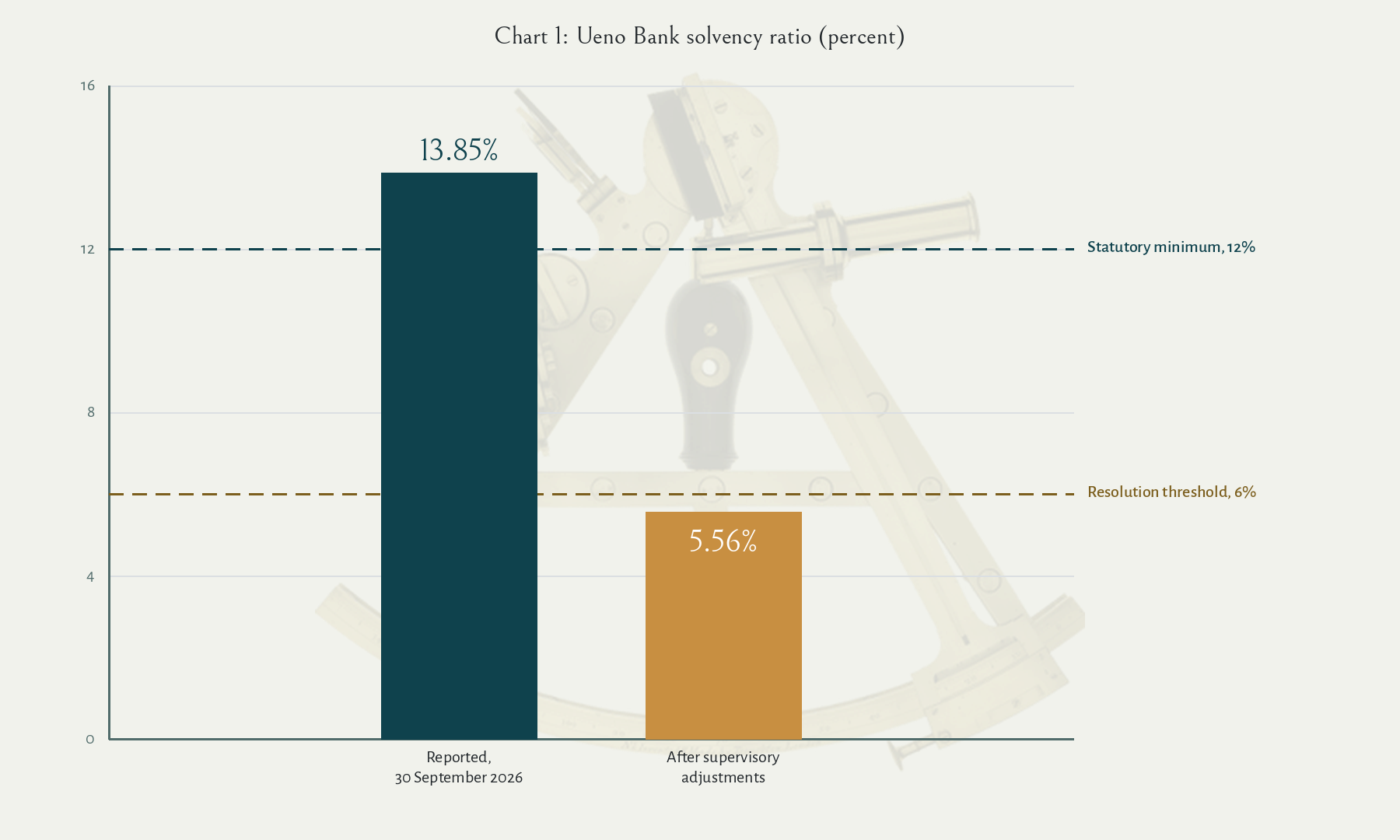
The statutory minimum for principal capital (Nivel 1) and complementary capital (Nivel 2) taken together is 12 percent; half of that is 6 percent.2 According to the BCP’s presentation to the courts, as reported by ABC Color and other Paraguayan outlets, the ratio after the adjustments was 5.56 percent.3 Six weeks earlier, at 30 September, the same presentation put it at 13.85 percent. S&P Global Ratings, downgrading the bank to D, published 13.8 percent as of that date.4
A solvency ratio does not lose eight points in six weeks because the loans went bad in October. It does so because the number reported in September was not an economic capital number. I suspect the true figure was never 13.85 percent.
A solvency ratio does not lose eight points in six weeks because the loans went bad in October.
The related-party lending was real, and it was the regulatory tripwire. It was not, by itself, the accounting event that destroyed the capital.
In its published balance sheet at 30 September 2026, Ueno reported shareholders’ equity of ₲2,525.1 billion, about US$433 million at the BCP’s reference rate of ₲5,833.63 per dollar that day, and year-to-date profit of ₲311.9 billion.5 Total assets were ₲26,386 billion. On 30 October, according to S&P, the bank still announced a US$100 million capitalization plan.
The hole opened when supervisors reclassified borrowers into higher risk categories and required additional loan-loss provisions of ₲1,621,853,458,972 — ₲1,621.9 billion, or about US$272 million at the 2 November reference rate of ₲5,965.76.6 That single adjustment is equal to 64 percent of the September equity.
The BCP’s 2 November resolution note, as quoted by ABC Color, described “significant weaknesses in credit-risk management” and “corporate, economic and financial relationships with companies linked to the entity.” A civil court, at the BCP’s request, then froze assets of the controlling companies and directors up to US$70 million plus the same ₲1,621.9 billion. The bank had also told the Superintendencia, according to that court filing as reported in the press, that it could not replenish a legal reserve, or encaje, of US$70 million.
Table 1 walks the published starting point to the resolution ratio. I have not reconstructed a post-adjustment equity figure; the BCP has not published the post-reclassification capital stack.
Table 1. Reported equity and solvency ratio, 30 September 2026 to the resolution figure. PYG billions, except ratios and U.S. dollar conversions.
| Item | Amount |
|---|---|
| Reported shareholders’ equity, 30 September 2026 | 2,525.1 |
| In US$ millions (BCP reference rate, 30 September 2026: ₲5,833.63) | 432.9 |
| Reported solvency ratio before supervisory adjustments | 13.85% |
| Additional loan-loss provisions after reclassification | 1,621.9 |
| In US$ millions (BCP reference rate, 2 November 2026: ₲5,965.76) | 271.9 |
| Additional provisions as a share of September equity | 64.2% |
| Solvency ratio after adjustments | 5.56% |
| Statutory minimum, Nivel 1 + Nivel 2 | 12% |
| Half of the statutory minimum (resolution threshold) | 6.0% |
Source: Ueno Bank S.A., published balance sheet at 30 September 2026 (equity). Additional provisions of ₲1,621,853,458,972 and solvency ratios of 13.85% and 5.56%: BCP presentation to the courts, as reported by ABC Color (3 November 2026) and contemporaneous press accounts of that filing; S&P Global Ratings (4 November 2026) published 13.8% as of 30 September 2026. BCP comunicado of 3 November 2026, as published by ABC Color, La Nación and Diario HOY. Statutory 12% minimum: Ley No. 5787/2016, as described in Ueno’s audited 2025 statements, note d.1. Exchange rates: BCP cotización referencial, 30 September and 2 November 2026. Dollar conversions, the 64.2% share and the 6.0% threshold: author’s calculations.
Chart 1. Ueno Bank solvency ratio, percent. Reported ratio at 30 September 2026, and the ratio after supervisory adjustments.

Source: solvency ratios of 13.85% and 5.56%, BCP presentation to the courts, as reported by ABC Color (3 November 2026) and contemporaneous press accounts of that filing. S&P Global Ratings (4 November 2026) published 13.8% as of 30 September 2026. Statutory 12% minimum: Ley No. 5787/2016, as described in Ueno’s audited 2025 statements, note d.1. The 6.0% resolution threshold is half of that minimum: author’s calculations.
The Credit Forbearance and the Merger Trust Were Not the Same Item
A large part of what those provisions finally recognized had been deferred. Ueno was a recently converted financiera. The BCP authorized it to operate as a bank on 22 November 2023; it began bank operations on 1 December.
In January 2024 it started the process of absorbing Visión Banco S.A.E.C.A., an older institution. The definitive authorization came on 21 June 2024, under BCP Resolution No. 22, Acta No. 27, with Ueno as the absorbing entity. In the notes to its audited 2025 financial statements, Ueno set out the facilidades the regulator had authorized inside the feasibility plan for that merger.7
They were not small, and they were of more than one kind. The bank was permitted to defer provisions on a portion of the absorbed loan book, ₲118.1 billion still unrecognized at 31 December 2025, and to recognize them linearly, with a maximum term of twenty years. Accumulated losses from Visión were also deferred. Provisions on assets received in recovery of Visión credits did not have to start until the fifth year after the merger.
The notes say that a portion of the absorbed portfolio was carried in current loans, créditos vigentes, under special valuation criteria, which is why the published overdue stock was only ₲55.1 billion at year-end 2024. The ₲118.1 billion is the deferred provision on that portion, about US$16 to 18 million at the rates prevailing from the merger through year-end 2025, not the principal of the book itself.
According to press reports, the deteriorated Visión book was much larger. ABC Color reported on 19 October 2024 that Juan Manuel Gustale, then Ueno’s president, confirmed that the BCP had authorized a twenty-year deferral of a deteriorated or uncollectible Visión portfolio of around US$300 million.8 On 10 November 2026, La Nación reported Alberto Acosta Garbarino, a director of the Asociación de Bancos del Paraguay (Asoban), distinguishing almost US$300 million of losses from about US$300 million of merger expenses, both deferred twenty years.9
Visión’s year-end 2023 figures, in the Solventa & Riskmétrica report drawn from its BDO-audited statements, already showed overdue loans of ₲490.8 billion, or 8.77 percent, and overdue plus refinanced, restructured and renewed loans (the 3R) of 24.17 percent, about ₲1,353 billion, or roughly US$186 million at the BCP’s year-end 2023 reference rate of ₲7,278.37, on a ₲5,598.1 billion book.10 That problem stock was already several times the deferred provisions.
Separately, the BCP authorized a fideicomiso, administered by Zeta Banco S.A.E.C.A., “to include investments and other concepts derived from the post-merger reorganization of the business model,” to be amortized on a straight line. The associated “Derechos Fiduciarios” line was ₲2,105.7 billion at year-end 2025, 99 percent of reported equity. ABC Color, on 20 August 2026, put that trust at US$353 million.11
That figure is not a hidden loan-loss reserve. It is a deferred cost and investment account that the bank was allowed to carry as an asset. The two items are distinct. The trust is reorganization cost. The Visión forbearance is credit.
Chart 3. Two different deferrals, US$ millions. The deferred Visión provision, the deteriorated Visión book reported in the press, and the merger reorganization trust are not the same item.

Source: deferred provisions of ₲118.1 billion and fideicomiso of ₲2,105.7 billion, Ueno Bank S.A., audited 2025 notes. Dollar range on the deferred provisions, author’s calculations, using BCP reference rates prevailing from the merger through year-end 2025. Deteriorated Visión book of around US$300 million: press reports (ABC Color, 19 October 2024, quoting Juan Manuel Gustale; La Nación, 10 November 2026, quoting Alberto Acosta Garbarino of Asoban). Dollar value of the trust, US$353 million: ABC Color, 20 August 2026.
The forbearance was there, and then it was not.
The forbearance was there, and then it was not.
In a 14 October notice, Ueno, reciting the BCP’s 7 October reply to the Senate, said the regulator had ratified the merger measures, including the deferral of a certain past-due Visión portfolio.12 Weeks later the inspection required ordinary classification. According to press reports of the BCP’s court presentation, additional provisions of ₲1,621.9 billion took the ratio to 5.56 percent. The official text of the 2 November resolution has not been published. The capital that forbearance had preserved was no longer there to use.
Chart 2. Ueno Bank, November 2023 to November 2026. Press-reported items are marked as such.

Source: bank authorization and Visión approval, and the 31 December 2025 deferred-provision and fideicomiso figures, Ueno Bank S.A., audited 2025 notes. 30 September 2026 equity, Ueno Bank S.A., published balance sheet. Gustale deferral comment, ABC Color, 19 October 2024. Related-party notice and return to the cap, BCP Senate reply, as reported in the press. 14 October notice, Ueno Bank S.A. Cartes announcement, as reported by La Nación, ABC Color and Última Hora. Última Hora, “Horacio Cartes anuncia que Honor Colorado no presentará candidatura para internas del 2027,” 18 October 2026, https://www.ultimahora.com/horacio-cartes-anuncia-que-honor-colorado-no-presentara-candidatura-para-internas-del-2027. Resolution vote and the 13.85% and 5.56% ratios, BCP comunicado and court presentation, as reported by ABC Color and other outlets, 3 November 2026.
The other deferred item was software. At 31 December 2025, the line “Bienes Intangibles – Sistemas” stood at ₲761.4 billion, after additions of ₲654.8 billion in a single year. That is 36 percent of year-end equity. The September 2026 quarterly notice does not break out software separately; the broader “Cargos Diferidos e Intangibles” line was still ₲795.7 billion, 31 percent of the September equity.
S&P, in its downgrade, wrote that the supervisory review had “uncovered irregularities in Ueno Bank’s credit portfolio, as well as capitalization of IT expenses that were not adequately substantiated.” In a regime that lets capitalized software count as part of the capital base, a write-down of those items is a capital event.
The tripwire that opened the file was related-party lending. Supervisors concluded that Mowi S.A., Grupo Hendy S.A. and Grupo M S.A. should be treated as linked to the bank. On 5 June 2026, according to the BCP’s later reply to the Senate as reported by Crónica, the Superintendencia de Bancos required the bank to regularize exposures; the bank said it was back inside the limits by 15 June.13 ABC Color, citing internal supervisory memoranda, described credits it said were large relative to the borrowers’ income and net worth.
The related-party finding is what forced a sustained look at the credit book. The ₲1,621.9 billion of additional provisions is what reduced the ratio to 5.56 percent. Those are not the same thing.
The official comunicado is more careful than some of the later commentary. It speaks of adjustments during a regularization process, not of a fraud finding. Ueno had, through September, reported a profit, and the BCP’s October Senate reply, as reported at the time, said the named related-party exposures had been brought back within prudential limits. I do not have a fraud finding. What I do have is a published capital ratio that could only exist while deferred losses, a merger fideicomiso, and a large stock of capitalized software were allowed to stand as assets.
Under U.S. capital rules, 12 CFR 217.22(a), a bank must already deduct goodwill and most other intangible assets, other than mortgage servicing assets, from Common Equity Tier 1 capital.14 That is the reverse of Ueno, where capitalized software appears to have counted in the capital base until a supervisor tested it.
Ueno Was Mid-Sized on the Books and Outsized in Reach
There is another reason this never should have passed muster, politics aside. By deposits and loans, Ueno was mid-sized: 9.1 percent of system deposits and 7.8 percent of loans in its June 2026 presentation, and in the high single digits at year-end 2025 in rating-agency reports.15 By reach it was something else.
Ueno itself reported in March 2026 more than 2.8 million clients, more than 60 percent of Paraguay’s adult population, and by June 2.94 million, about 63 percent of adults, with 28 percent of instant transfers.16 Those are the bank’s own figures, later repeated in the press.
Press reports of Ministry of Economy and Finance figures put state and public-sector funds at Ueno at about US$850 million at the end of September 2026, including US$348.5 million from the Instituto de Previsión Social (IPS), according to its September schedules as reported by 5días.17 Against Ueno’s published non-financial intermediation liabilities of ₲16,909.4 billion that day, about US$2.90 billion, the public funds were on the order of 29 percent of the book.
Chart 4. Mid-sized on the books, outsized in reach.

Source: deposit share 9.1% and loan share 7.8%, and the June adult-client claim of about 63% (2.94 million clients), Ueno Bank S.A., Q2 2026 earnings presentation. The March claim of more than 60% (more than 2.8 million clients), Q1 2026 earnings presentation. Public-sector funds of about US$850 million: press reports of Ministry of Economy and Finance figures at end-September 2026 (Parámetro and others). IPS US$348.5 million: IPS September 2026 investment and availability schedules, as reported by 5días. Share of the funding book (~29%) and the residual, author’s calculations, from Ueno’s published non-financial intermediation liabilities of ₲16,909.4 billion at 30 September 2026 (about US$2.90 billion at the BCP reference rate of ₲5,833.63).
Law No. 861/1996, the General Law of Banks, Finance Companies and Other Credit Institutions, caps credits to persons linked to a bank’s ownership or management at 20 percent of effective equity.18 According to the BCP’s Senate reply, as reported in the press, Ueno had gone through that limit, was notified on 5 June, and said it was back inside by 15 June. On the surface, it had passed.
A bank that already combined this kind of client reach with a large book of public money, and that had already tested the related-party cap, is not one whose concentrations should have been waved through. An investor looking at those facts should have stopped, even while the reported ratio was still 13.85 percent.
The Forbearance Was Politically Convenient Until It Was Not
Ueno is an illustrative case. Things can look legally correct and still be dangerous. The forbearance was approved, and the accounts were audited, with a reported solvency ratio of 13.85 percent. The underlying situation was not what that number said. You have to understand the politics as well.
The weakness was always there. None of this was a surprise. I have seen no document showing that anyone directed the supervisors, and I am not suggesting any individual did so. What follows is my reading of a sequence of public events.
Carvallo resigned as president of Financiera Ueno weeks before his September 2023 appointment as BCP president.21 He was still BCP president when the board approved the Visión absorption, with the facilidades, in June 2024.7 Juan Manuel Gustale, then Ueno’s president, told ABC Color in October 2024 that Carvallo had recused himself from the operation and that the other four members of the board had issued the resolutions.22 I could not confirm whether he recused himself from a public BCP document.
On 18 October 2026, Horacio Cartes announced that Honor Colorado, the Colorado Party movement that had backed President Santiago Peña, would not field candidates in the 2027 party internals.19 Press reports that week described a public rupture between Cartes and Peña.
The bank went into resolution on 2 November 2026,1 after the supervisors completed their capital calculation, a review that press reports of the BCP’s reply to the Senate say had been under way since at least June.13 I cannot say whether the political shift that month played any part.
In my view, the politics shaped the timing: forbearance was convenient while the alliance held, and ending it became convenient once it broke.
A Regulatory Sign-Off Does Not Mean You Turn Your Brain Off
The depositors are now in the resolution regime under Law No. 2,334/03. The official guarantee is 75 monthly minimum wages, ₲228.3 million per depositor and entity.20 Recovery above that ceiling will be a later story.
The accounting story is already visible. Forbearance can keep a ratio in the mid-teens until the day a supervisor withdraws it. The economic capital was the number after the deductions. It was the number that showed up in November.
This was a bank that, according to press reports of Ministry figures, held about US$850 million of state and public-sector money, including US$348.5 million from IPS,17 and whose regulator was chaired by a former president of Financiera Ueno when the merger forbearance was approved.21 A regulatory sign-off does not mean you turn your brain off.
“Meet the new boss / Same as the old boss.”
— The Who, “Won’t Get Fooled Again”
Disclosure: This is commentary by Robert J. Lacoursière, published by Cybiont Capital, LLC. It is not research coverage or investment advice, and it is not an offer or solicitation to buy or sell any security. Cybiont Capital does not cover Ueno Bank or any Paraguayan financial institution. Neither Cybiont Capital, LLC, its partners Robert J. Lacoursière and Allen Puwalski, nor their households hold a position in any security of Ueno Bank, its affiliates or related entities, and none of them plans to trade them. Statements about third parties rest on the public sources cited and on the author's opinion.
This note is general information and commentary from Cybiont Capital, LLC. It is not investment advice, a recommendation, or an offer to sell securities, and it is not tailored to any reader's circumstances. It does not create an adviser-client relationship. Views are as of the date of publication. We have no duty to update them. Cybiont, its partners, and accounts they own or control may hold positions in securities discussed. See the position disclosure above and our full disclaimer.
- Banco Central del Paraguay, comunicado announcing the start of the resolution procedure for Ueno Bank S.A., 3 November 2026 (board resolution dated 2 November 2026), as published and quoted by ABC Color, La Nación and Diario HOY. ABC Color, “Ueno Bank: el BCP anuncia ‘procedimiento de resolución’,” 3 November 2026, https://www.abc.com.py/economia/2026/11/03/ueno-bank-el-bcp-anuncia-procedimiento-de-resolucion/; La Nación, “El BCP dispone resolución de ueno bank,” 3 November 2026, https://www.lanacion.com.py/negocios/2026/11/03/el-bcp-dispone-resolucion-de-ueno-bank/; Diario HOY, “BCP constata insuficiencia en solvencia de ueno y ordena intervención,” 3 November 2026, https://www.hoy.com.py/nacionales/2026/11/03/bcp-constata-insuficiencia-en-solvencia-de-ueno-y-ordena-intervencion. ↩
- Statutory 12% minimum: Ley No. 5787/2016, as described in Ueno Bank S.A., audited financial statements at 31 December 2025, note d.1, https://www.ueno.com.py/wp-content/uploads/2026/04/ueno-bank-SA-EECC-Auditados-2025.pdf. The 6.0% resolution threshold is half of that minimum: author’s calculations, matching the comunicado’s “50 percent of the legal minimum” test. ↩
- Additional provisions of ₲1,621,853,458,972 and solvency ratios of 13.85% and 5.56%: BCP presentation to the courts, as reported by ABC Color (3 November 2026) and contemporaneous press accounts of that filing. ABC Color, “Caso Ueno Bank: ordenan embargo a directivos y empresas accionistas,” 3 November 2026, https://www.abc.com.py/economia/2026/11/03/caso-ueno-bank-ordenan-embargo-a-directivos-y-empresas-accionistas/. The official text of the 2 November board resolution has not been published. ↩
- S&P Global Ratings, “Ueno Bank S.A. Downgraded To ‘D’ From ‘BB’,” 4 November 2026, https://spratings.spglobal.com/ratings/en/regulatory/article/-/view/type/HTML/id/3654529. ↩
- Ueno Bank S.A., Balance Trimestral, statement of financial position at 30 September 2026, https://www.ueno.com.py/wp-content/uploads/2026/10/Aviso-Balance-255x35cm_sep2026-3.pdf. Exchange rates: Banco Central del Paraguay, Cotización Referencial de Monedas — Histórico Anual, 30 September 2026 (₲5,833.63) and 2 November 2026 (₲5,965.76), https://www.bcp.gov.py/webapps/web/cotizacion/monedas-historica. Dollar conversions: author’s calculations. ↩
- See note 3 for the provision figure, as reported in the press from the BCP’s court presentation, and note 5 for the 2 November exchange rate. The 64.2% share of September equity is author’s calculations. The asset freeze of US$70 million plus ₲1,621.9 billion, and the encaje shortfall, are from that court filing as reported in the press (ABC Color, 3 November 2026). ↩
- Ueno Bank S.A., audited financial statements at 31 December 2025 and 2024, notes c.5, c.7, c.9, c.18 and d.1, https://www.ueno.com.py/wp-content/uploads/2026/04/ueno-bank-SA-EECC-Auditados-2025.pdf. The ₲118.1 billion deferred-provision figure, the ₲55.1 billion published overdue stock at year-end 2024, the ₲2,105.7 billion “Derechos Fiduciarios” line, and the ₲761.4 billion “Bienes Intangibles – Sistemas” line are from these notes. The September 2026 “Cargos Diferidos e Intangibles” line of ₲795.7 billion is from the quarterly notice cited in note 5. The US$16 to 18 million range on the deferred provisions is author’s calculations, using BCP reference rates prevailing from the merger through year-end 2025. ↩
- ABC Color, “El BCP autorizó diferir incobrables de banco absorbido por ueno, hasta 20 años,” 19 October 2024, https://www.abc.com.py/economia/2024/10/19/el-bcp-autorizo-diferir-incobrables-de-banco-absorbido-por-ueno-hasta-20-anos/. Press report, not a figure from the filings. ↩
- La Nación, “Situación de Ueno Bank fue anormal desde sus inicios, afirma director de la Asoban,” 10 November 2026, https://www.lanacion.com.py/negocios/2026/11/10/situacion-de-ueno-bank-fue-anormal-desde-sus-inicios-afirma-director-de-la-asoban/. Press report. ↩
- Solventa & Riskmétrica, rating report on Visión Banco S.A.E.C.A. at 31 December 2023 (based on financial statements audited by BDO), https://syr.com.py/wp-content/uploads/2024/04/Informe-de-Calificacion-Vision-Dic23.pdf. The dollar conversion of the overdue-plus-3R stock uses the Banco Central del Paraguay cotización referencial of ₲7,278.37 on 28 December 2023, the last published business close of the year (31 December 2023 was a Sunday), retrieved from BCP, Cotización Referencial de Monedas — Histórico Anual, https://www.bcp.gov.py/webapps/web/cotizacion/monedas-historica. ₲1,353,063 million ÷ ₲7,278.37 = US$185.9 million, shown as roughly US$186 million. ↩
- ABC Color, “Otro dato llamativo del balance de Ueno: registra en un fideicomiso US$ 353 millones, casi el 100% de su patrimonio,” 20 August 2026, https://www.abc.com.py/economia/2026/08/20/otro-dato-llamativo-del-balance-de-ueno-registra-en-un-fideicomiso-us-353-millones-casi-el-100-de-su-patrimonio/. The ₲2,105.7 billion PYG figure is from the audited 2025 notes (see note 7); the US$353 million figure is as reported by ABC Color. ↩
- Ueno Bank S.A., “Actualización sobre el informe del BCP al Senado,” 14 October 2026, https://www.ueno.com.py/2026/10/14/actualizacion-sobre-el-informe-del-bcp-al-senado-y-sus-declaraciones-respecto-a-la-situacion-del-sistema-financiero-paraguayo/. ↩
- Related-party notice of 5 June 2026 and the bank’s statement that it was back inside the limits by 15 June: BCP Senate reply, as reported by Crónica, “BCP confirma que ueno bank adoptó medidas sobre empresas vinculadas,” 8 October 2026, https://www.cronica.com.py/2026/10/08/bcp-confirma-que-ueno-bank-adopto-medidas-sobre-empresas-vinculadas/, and Ahendu, “El BCP explica al Senado que ueno bank corrigió en plazo su exceso de créditos a vinculados,” https://ahendu.com.py/economia/ueno-bank-informe-bcp-senado-limite-vinculados-corrigio-en-plazo. ABC Color, “BCP detectó maniobras de Ueno Bank para ocultar nexos con empresas,” 8 October 2026, https://www.abc.com.py/economia/2026/10/08/bcp-detecto-maniobras-de-ueno-bank-para-ocultar-nexos-con-empresas/. ↩
- 12 CFR 217.22(a), https://www.ecfr.gov/current/title-12/chapter-II/subchapter-A/part-217/subpart-C/section-217.22. ↩
- Ueno Bank S.A., Q2 2026 Earnings Presentation (as of June 2026: 9.1 percent deposit share, 7.8 percent loan share), https://www.ueno.com.py/inversores/wp-content/uploads/sites/3/2026/07/Ueno-Bank-Q22026-Earnings-Presentation.pdf. Year-end 2025 high-single-digit deposit and loan shares: Fitch Ratings, Ueno Bank S.A. update, March 2026 (8.7 percent of system deposits and 5.8 percent of loans at 31 December 2025); FIX SCR, Ueno Bank rating report, 31 March 2026 (8.9 percent of deposits and 5.9 percent of loans at year-end 2025), https://www.ueno.com.py/wp-content/uploads/2026/03/Ueno_Bank_Full-Rating-Report_Mar.2026.pdf. ↩
- Ueno Bank S.A., Q1 2026 Earnings Presentation (as of March 2026: more than 2.8 million clients, more than 60 percent of the adult population, 28 percent bank-transfer share), https://www.ueno.com.py/inversores/wp-content/uploads/sites/3/2026/05/Ueno-Bank-Q12026-Earnings-Presentation.pdf; Q2 2026 Earnings Presentation (as of June 2026: 2.94 million clients, about 63 percent of the adult population, 28 percent instant-transfer share). These are the bank’s own figures, later repeated in the press, not an official census. ↩
- Public-sector funds of about US$850 million: press reports of Ministry of Economy and Finance figures at end-September 2026. Parámetro, “Más de US$ 852 millones de fondos públicos comprometidos tras el cierre de Ueno,” https://elparametro.com/mas-de-us-850-millones-de-fondos-publicos-comprometidos-tras-el-cierre-de-ueno; EFE, “Fondos públicos: el mayor quebradero de cabezas tras intervención de Ueno bank en Paraguay,” 9 November 2026, https://efe.com/economia/2026-11-09/ueno-bank-riesgo-fondos-publicos-paraguay-recursos-ahorros/. IPS US$348.5 million: 5días, “El IPS tiene US$ 348,5 millones de fondos previsionales en Ueno Bank,” reporting IPS September 2026 investment and availability schedules, https://5dias.com.py/article/el-ips-tiene-us-3485-millones-de-fondos-previsionales-en-ueno-bank. The ~29 percent share is author’s calculations against Ueno’s published non-financial intermediation liabilities of ₲16,909.4 billion at 30 September 2026 (about US$2.90 billion at ₲5,833.63). ↩
- Ley No. 861/1996, Ley General de Bancos, Financieras y Otras Entidades de Crédito, article 59 (20 percent of effective equity for credits to persons linked to ownership or management). Article 64’s single-borrower cap is not cited in the body as having been breached. ↩
- Horacio Cartes, announcement that Honor Colorado would not field 2027 internal-election candidacies, 18 October 2026, as reported by La Nación, ABC Color and Última Hora. La Nación, “Honor Colorado no presentará candidaturas nacionales ni partidarias para las internas,” 18 October 2026, https://www.lanacion.com.py/politica/2026/10/18/honor-colorado-no-presentara-candidaturas-nacionales-ni-partidarias-para-las-internas/; ABC Color, “Sin reelección de Cartes ni chapa propia: HC se retira de las internas coloradas del 2027,” 18 October 2026, https://www.abc.com.py/politica/2026/10/18/horacio-cartes-anuncia-que-honor-colorado-no-presentara-candidato-a-la-anr-en-2027/. ABC Color described the announcement as closing “una semana cargada de cambios traumáticos en Honor Colorado,” as a new movement “impulsado por el presidente Santiago Peña” advanced. Peña had been Honor Colorado’s candidate in the Colorado Party’s 18 December 2022 presidential internal: ABC Color, “Tribunal de la ANR divulga resultados finales de las internas partidarias,” 30 December 2022, https://www.abc.com.py/politica/2022/12/30/tribunal-de-la-anr-divulga-resultados-finales-de-las-internas-partidarias/. ↩
- Resolution regime and official deposit guarantee of 75 monthly minimum wages, ₲228.3 million per depositor and entity: Law No. 2,334/03, as described in the official resolution coverage. ↩
- Carlos Carvallo’s appointment as BCP president: Decreto No. 214/2023, as reported by ABC Color, “Confirman a Carlos Carvallo como nuevo presidente del Banco Central del Paraguay,” 1 September 2023, https://www.abc.com.py/economia/2023/09/01/confirman-a-carlos-carvallo-como-nuevo-presidente-del-banco-central-del-paraguay/, which also states that he had lately been in “la presidencia de la financiera Ueno Paraguay.” ABC Color, “Financiera ueno inicia trámites de conversión a banco,” 19 August 2023, https://www.abc.com.py/economia/2023/08/19/financiera-ueno-inicia-tramites-de-conversion-a-banco/, reported that he had resigned the Ueno presidency weeks earlier after being nominated to the BCP. He was still BCP president when the Visión absorption was authorized on 21 June 2024 (BCP Resolution No. 22, Acta No. 27, as recited in Ueno’s audited 2025 notes). ABC Color, “El BCP autorizó diferir incobrables de banco absorbido por ueno, hasta 20 años,” 19 October 2024, https://www.abc.com.py/economia/2024/10/19/el-bcp-autorizo-diferir-incobrables-de-banco-absorbido-por-ueno-hasta-20-anos/, identifies him as BCP president and a former Ueno president. ↩
- Juan Manuel Gustale, then president of Ueno Bank, as reported by ABC Color, “El BCP autorizó diferir incobrables de banco absorbido por ueno, hasta 20 años,” 19 October 2024, https://www.abc.com.py/economia/2024/10/19/el-bcp-autorizo-diferir-incobrables-de-banco-absorbido-por-ueno-hasta-20-anos/. Under the heading “Carvallo se inhibió, afirman,” the article reports Gustale as saying that Carvallo “se habría inhibido” and that the other four members of the BCP board (Liana Caballero, Humberto Colmán, Carmen Marín and Fernando Filártiga) approved the operation and issued the resolutions. I have not seen a public BCP document confirming that recusal, including for Resolution No. 22, Acta No. 27, of 21 June 2024. ↩

You must be logged in to post a comment.