
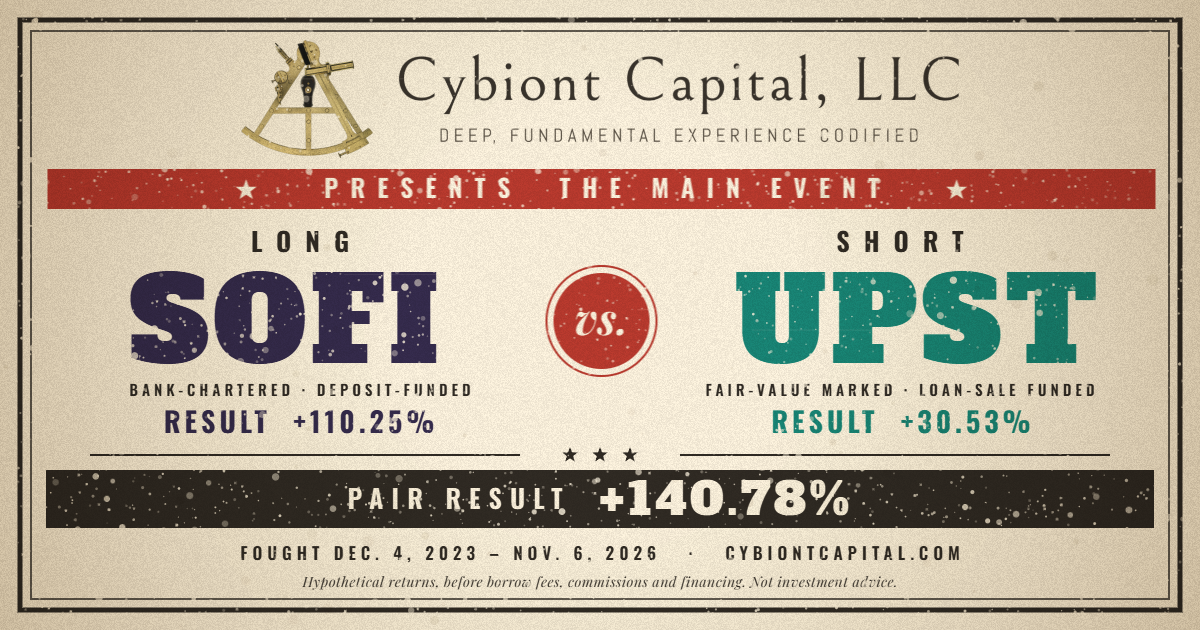
This post is a musing, not a victory lap. Had you gone long SoFi and shorted Upstart when we first talked about it, you probably would have given up around the time you lost all your investment and then some (see below).
This post is more about patience, a little about faith, and maybe even a bit about providence (what some call luck).
Martin Luther King Jr. famously said, “The arc of the moral universe is long, but it bends toward justice.”1 Now, none of this is as serious as all that. But investors should trust that the arc of valuation is long, but it bends, if not resolutely, then at least eventually, toward the fundamentals.
On December 2, 2023, with SoFi the target of what looked to us like a coordinated short attack, we published Debunking the Short Thesis on SoFi. We disclosed up front that we were talking our own book: long SOFI and short UPST. We also told readers that even if they thought the claims against SoFi had some merit, they would still do well to pair trade it against UPST.
I fondly remember my dad was a great blue-collar philosopher. One of his go-to expressions was, “Oh, you’re goanna be right…dead right!”
That’s what shorting and even pair trading often feel like.
So, almost three years later, it’s fair to ask how that trade held up, not just now, but along the way. Today’s scorecard hides a path of carnage along the way.
The Result
Table 1: Long SOFI / short UPST pair trade, December 4, 2023 to November 6, 2026
| Position | Entry (Dec 4, 2023 open) | Nov 6, 2026 close | Return |
|---|---|---|---|
| Long SOFI | $7.71 | $16.21 | +110.25% |
| Short UPST | $31.51 | $21.89 | +30.53% |
| Pair (long + short) | +140.78% |
Source: Yahoo Finance daily prices; Cybiont Capital Research. Returns are before stock borrow fees, commissions and financing.
Every $1 held long in SOFI against $1 held short in UPST made about $1.41. That is nearly double the 70.42% return on the Nasdaq-100 over the same period. Both legs made money: SoFi more than doubled, and Upstart fell about 31%. Neither stock paid a dividend or split over the period, so the price returns are the total returns. Measured from the close on Friday, December 1, 2023, the last price before our post, the pair returned +139.40%.
It was anything but a Fun Ride
A victory lap that left out the path would be exactly the kind of selective truth-telling we warned readers about. The pair spent most of its first 15 months below water. In the week of November 4, 2024, Upstart had more than doubled from our entry, and the pair was down 88%. The short UPST leg alone was down as much as 168% in December 2024. The pair last closed a week below zero on March 3, 2025, and it peaked at +243% in early November 2025 before giving some of that back a lot as SoFi sold off this year.
That is what we meant when we wrote that short selling isn’t for the faint of heart. A pair trade doesn’t remove that risk. Sometimes it doesn’t even feel like it reduces risk. It changes what you are betting on, from the direction of the market to the divergence between two companies, and the short leg has to be sized so you can hold through the stretches when the market disagrees with you.
What We Said About Short Selling
The opening of our December 2023 report is worth repeating, because it explains both the trade and how we think about short selling:
Short attacks…are increasingly common in today’s investor landscape, which is metabolizing a significant influx of retail investors that haven’t yet determined whose investment advice can be trusted. So, if you are an investor, you should probably be able to identify a short attack and know how to independently evaluate the merits of a short thesis without falling for incendiary rhetoric that is likely more a function of the speaker’s investment position than their analytical qualifications or convictions.
Robert and I have both spent the most lucrative parts of our careers as short sellers with John Paulson during the global financial crisis (GFC). So, we know a good short when we see it. Short sellers can benefit markets because their presence reduces irrational competition and leads to improved risk balances in the market.
Short selling isn’t for the faint of heart, though. That’s why we prefer pair trading companies that may have similarities in economic drivers but that diverge in management’s relative conservatism and most importantly the use of accounting practices that may make the companies appear similar today but that are likely to diverge as the accounting or rhetoric wears thin against the real trends in the underlying business fundamentals.
To quickly summarize our position, we are short UPST because we believe that it has weaponized its accounting latitude to mask both the vulnerability of its business model and the deterioration in its real economic prospects. Admittedly it is both puzzling and frustrating that any of the criticisms that are being hurled at SoFi, are orders of magnitude truer for UPST.
Since our largest “long” position is the reputation that we are developing as an investment firm, we do not view engaging in such tactics as long-term profitable. But we invite you to judge for yourselves.
Debunking the Short Thesis on SoFi, December 2, 2023
Almost three years on, readers can judge for themselves.
We’ve Been Following These Two for a Long Time
This trade wasn’t a one-off call. We have been writing about Upstart’s accounting and credit since the summer of 2023:
- Upstart (UPST), AI Hype, and Credit Underwriting (August 4, 2023), followed by two updates the same month
- Upstart (UPST): A Traditional Non-Prime Unsecured Loan Originator Masquerading as An AI Fintech (August 31, 2023)
- UPST: Why Do You Make E Grade Loans? (September 18, 2023)
- Debunking the Short Thesis on SoFi (December 2, 2023)
- A Quick Look at Compass Point’s March 20, 2024, SoFi Report (March 22, 2024)
- Upstart’s Long Road to Becoming a Bank (November 2, 2026)
- Reevaluating Upstart’s Capital After the “First-Loss” Pushback (November 5, 2026)
- Upstart Equity Lives Inside Fair-Value Assumptions That Keep Missing Their Own Test (November 6, 2026)
Disclosures
The returns above are hypothetical. They show what a reader would have earned by putting on the trade described in our December 2, 2023 post at the next available price and holding it to November 6, 2026, using equal dollar amounts on each side. They are not Cybiont’s actual results, and they exclude stock borrow fees, commissions, margin financing and taxes, which would have reduced them. Past performance does not guarantee future results. Nothing in this post is investment advice or a recommendation to buy or sell any security. Price data: Yahoo Finance.
1 King used the line several times, most famously on March 25, 1965, on the steps of the Alabama State Capitol at the end of the Selma-to-Montgomery march (“Our God Is Marching On!”, also known as the “How Long, Not Long” speech): “How long? Not long, because the arc of the moral universe is long, but it bends toward justice.” He returned to it in “Remaining Awake Through a Great Revolution,” his sermon at Washington National Cathedral on March 31, 1968. King was paraphrasing the abolitionist Unitarian minister Theodore Parker, “Of Justice and the Conscience,” in Ten Sermons of Religion (1853): “I do not pretend to understand the moral universe; the arc is a long one, my eye reaches but little ways; I cannot calculate the curve and complete the figure by the experience of sight; I can divine it by conscience. And from what I see I am sure it bends towards justice.” ↩

Leave a Reply