
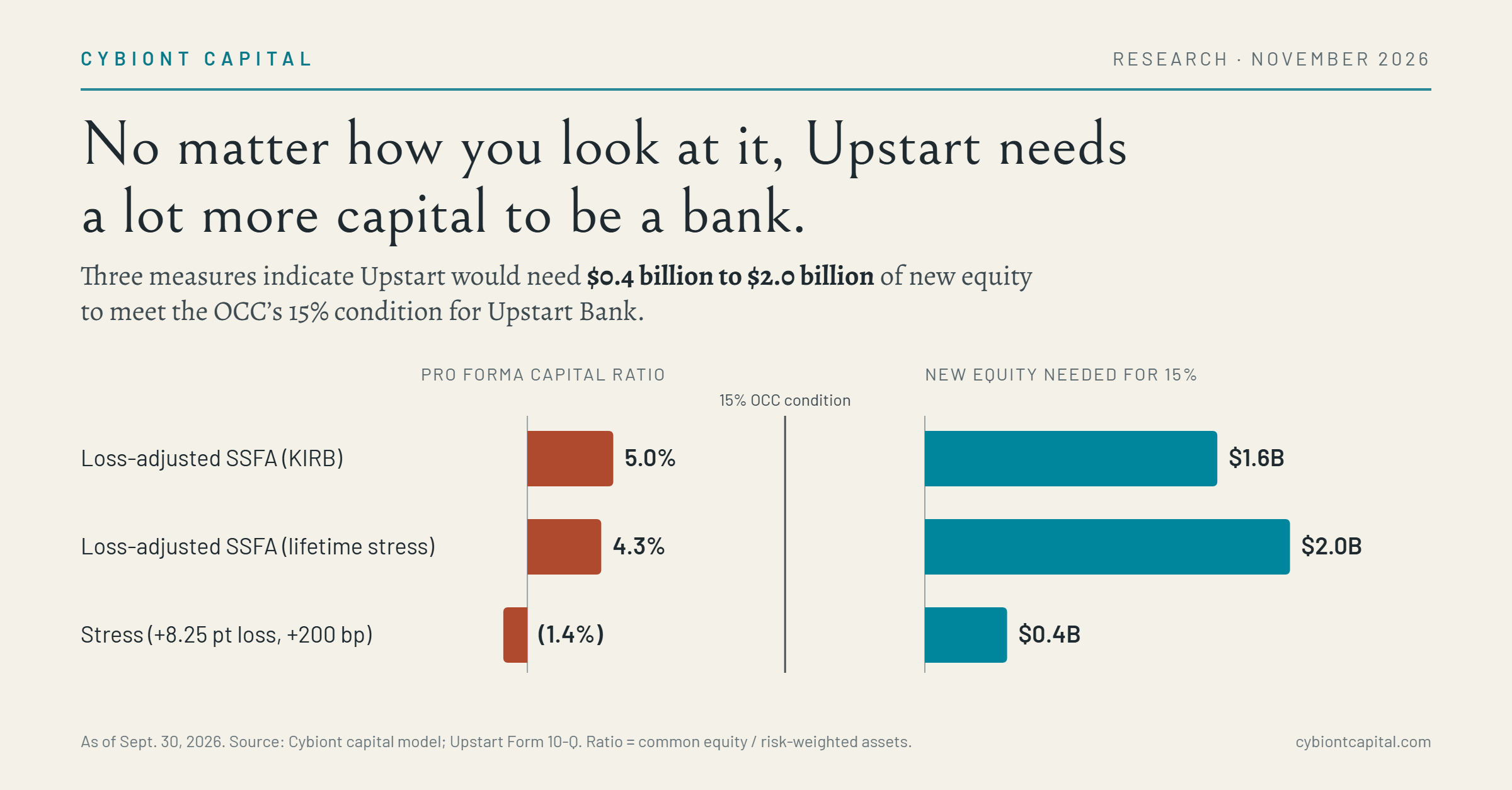
No matter how you look at it, Upstart needs a lot more capital to be a bank.
Cybiont is relaunching its research. Our analysis of banks, fintechs and bank regulation is free to read; our models, tools and data are for subscribers. Subscribing is free during the relaunch. When we introduce a paid tier, existing subscribers will be offered founding-member pricing.
Summary
In our earlier work on the proposed Upstart Bank, N.A., we treated the risk-sharing positions that Upstart (UPST) takes in its committed-capital and co-investment arrangements as first-loss exposures carrying a 1,250 percent risk weight. We have received pushback on that assumption, and it is fair: Upstart does not disclose where these positions rank. Upstart’s understanding, as relayed to us by a coverage analyst, is that their risk weights would be more than 100 percent but presumably significantly less than 1,250 percent. Though unconfirmed, this seems to imply that some of the positions would be risk-weighted under a version of the Simplified Supervisory Formula Approach (SSFA) in the U.S. capital rule, which, as we demonstrate below, is not fit for securitization assets that sit primarily behind below-prime unsecured consumer lending such as Upstart’s.
The SSFA is not the correct capital policy to apply to Upstart because it results in too low a capital charge for the risk embedded in Upstart’s securitization assets. Three independent lines of analysis lead to the same conclusion:
- The SSFA does not adjust for high expected-loss assets. In effect, the SSFA calibrates to a pool with low expected losses and treats any securitization exposure that attaches above 8.8 percent of pool losses as senior to the pool’s capital requirement. Upstart’s positions pay or receive around initial expectations, so they likely attach near expected loss, about 16.5 percent. The SSFA would assign such an exposure a risk weight of about 78 percent, even though it absorbs more than 80 percent of any increase in pool losses.
- An analog to current expected credit losses (CECL) accounting shows that part of Upstart’s equity rests on interest its loans have not yet earned. Under CECL, the full $160 million of expected loss on Upstart’s loans would be reserved up front. Under fair value, only $35 million is; the other $125 million is offset by interest the loans have not yet paid. If losses run above expectations, Upstart is hit twice: the extra losses reduce equity directly, and the projected spread already counted as equity shrinks, because defaulted borrowers stop paying interest and the best borrowers refinance away.
- The values are highly volatile, and Upstart’s own disclosures prove it. A 3.3 percentage point increase in expected lifetime losses, from about 16.5 to 19.8 percent, would cut the value of Upstart’s risk-sharing positions by about $280 million (September 30, 2026), or 46 percent of their fair value, implying Upstart absorbs roughly 80 to 85 percent of any increase in losses on more than $10 billion of investor-held loans. An increase of about 8.25 percentage points, to about 24.75 percent, together with related losses on loans and retained interests and a 200 basis point rise in discount rates, would exceed all of the equity that would qualify as Upstart’s Common Equity Tier 1 (CET1) capital once it becomes a bank holding company (qualifying CET1).
To put numbers on these points, our capital model (available to subscribers) measures Upstart’s capital five ways. Under the SSFA, Upstart’s qualifying CET1 equals 29.0 percent of its risk-weighted assets, far above any minimum. Three methods tell a different story: two correct the SSFA for high expected losses, and a third subtracts the losses Upstart would take in a stress scenario. Under each of these, Upstart would need to raise roughly $0.4 billion to $2.0 billion of new equity to meet the 15 percent total risk-based capital ratio the Office of the Comptroller of the Currency (OCC) required of Upstart Bank. All three would fall short even of 10.5 percent, the total capital minimum plus buffer that applies to banks generally. The fifth method, which deducts the $125 million of expected loss that fair value does not reserve, leaves Upstart above the OCC’s 15 percent, but still conceptually points to the precarious nature of its equity. Subscribers can change the model’s assumptions in the calculator at the end of this report.
1. The complexity and inadequate disclosure of the credit-enhancing assets and liabilities
1.1 What Upstart discloses
Upstart’s Form 10-Q filings describe two kinds of beneficial interest arising from its committed-capital and co-investment arrangements:
- Hybrid instruments: Upstart makes an initial investment and receives a share of loan repayments that varies with credit performance. At June 30, 2026, these had a fair value of $519.1 million on $6.32 billion of referenced loan principal. Economically, this resembles a residual interest in the investor’s loan vehicle. The valuation note says the cash flows depend on contractual terms “such as total return,” which suggests investors are paid toward a target return and Upstart absorbs the variation around it.
- Derivatives: Upstart pays or receives cash when credit performance on the underlying loans “deviates from initial expectations, subject to a dollar cap.” At June 30, 2026, derivative assets had a fair value of $26.9 million on $2.93 billion of principal, with derivative liabilities of $10.2 million on $2.87 billion. This resembles a capped credit guarantee on the investor’s loans. For capital purposes, the exposure on protection Upstart has sold is generally the amount it could be required to pay, not the fair value1, which is why we estimate exposure using Upstart’s maximum exposure to loss, including pledged cash.
Beneficial interest assets were $176.8 million at December 31, 2024, $396.2 million at December 31, 2025, $545.9 million at June 30, 2026, and $613.7 million at September 30, 2026, about 3.5 times their level 21 months earlier. Beneficial interest liabilities, amounts Upstart expects to owe on underperforming pools, rose from $5.1 million to $20.6 million over the first nine months of 2026. Upstart’s chief financial officer described recent write-downs on the Q3 2026 call as associated with its “risk capital position.” The filings do not use the terms first loss, junior or subordinate, and do not describe where the positions rank.
The valuation inputs at September 30, 2026 are consistent with a junior, loss-absorbing claim. Upstart discounts the beneficial interest assets at a weighted 12.38 percent (12.57 percent for the liabilities), well above the 9.99 percent it used for whole loans at June 30. Expected cumulative net losses on the asset pools are running about 0.17 percentage points above their initially underwritten level, up from 0.15 points at December 31, 2025, and about 0.7 points above it on the pools where Upstart owes money, with some as much as 4.7 points above it (assuming an original loss rate of about 16.5 percent). Prepayments are running about 3.8 percent faster than expected, which shortens the excess interest these positions depend on.
1.2 How the Simplified Supervisory Formula Approach (SSFA) works and how it doesn’t
Under the SSFA, the risk weight on a securitization exposure, here Upstart’s beneficial interests and the cash it has pledged behind them, depends on its attachment point (A), the level of pool losses at which Upstart starts to absorb losses, and its detachment point (D), the level at which Upstart’s exposure is exhausted, each relative to KA, the SSFA’s measure of the capital the underlying pool requires. KA is calculated as (1 − W) × KG + 0.5 × W, where KG is the standardized capital charge on the underlying loans and W is the share of the pool that is seriously delinquent. For consumer loans, KG is 8 percent; with W at 2 percent, KA is 8.8 percent. Holding the thickness of Upstart’s exposure (D minus A) at about 11.7 percent of the referenced pool (about $1.21 billion of exposure, divided by about $10.4 billion of principal; the exposure is $613.7 million of beneficial interests at September 30, 2026, plus about $600 million of cash and restricted cash pledged under these arrangements, estimated from June 30 disclosures. Upstart’s total maximum exposure to loss, about $1.29 billion at June 30, appears also to include its securitization risk retention, which we treat separately in Section 2):
| Attachment point | SSFA | SFA-consistent | Lifetime stress | Reading |
|---|---|---|---|---|
| 0% | 1,171% | 1,250% | 1,250% | Near first loss |
| 5% | 804% | 1,250% | 1,250% | |
| 10% | 338% | 1,249% | 1,250% | |
| 15% | 109% | 1,128% | 1,250% | |
| 16.5% (expected loss) | 78% | 1,058% | 1,250% | Likely attachment; model default |
| 20% | 35% | 851% | 1,250% |
Source: Cybiont capital model. The SFA-consistent column, named for the supervisory formula approach (SFA), and the lifetime-stress column are the two loss-adjusted SSFA versions, Methods 2 and 3 in Section 5, described in Section 2.
A risk weight between 100 and 1,250 percent under the SSFA corresponds to an attachment point between roughly 0 and 15 percent of the referenced pool. The gap is widest at the attachment points that matter for Upstart. At 16.5 percent, the SSFA assigns a risk weight of 78 percent, while the loss-adjusted versions that we model assign 1,058 and 1,250 percent, and at 20 percent the SSFA weight falls to 35 percent while the loss-adjusted weights stay above 850 percent. Upstart’s positions pay or receive around initial expectations: the derivatives settle on deviations from expected credit performance, and the hybrid securities’ cash flows adjust around a contractual total return to investors. That places the economic attachment point near expected loss, about 16.5 percent. Upstart’s sensitivity disclosures are consistent with this. Section 4 shows that Upstart absorbs about 82 percent of any increase in pool losses. An exposure of this thickness absorbs that much only if pool losses fall inside its band, between A and D. That rules out an attachment point of 20 percent or more, which would imply Upstart absorbs less than 40 percent. Two ranges fit the 82 percent absorption of loss: roughly 15 to 17 percent, and roughly 6 to 10 percent, where the band would end just above expected loss. The contract terms seem to point to the higher range. Either way, the attachment point seems to sit at or near our best guess at expected loss. Because the SSFA does not take the expected losses on the underlying loans into account, it misses this risk: at an attachment point of 16.5 percent, it assigns a risk weight of about 78 percent, less than the 100 percent the same loans would carry if held directly, even though Upstart’s own disclosures (Section 4) show it absorbs most of any increase in losses beyond initial expectations. The plain SSFA reaches 100 percent only at attachment points below about 15 percent, so the range Upstart describes implies one of three things: the positions attach lower than the contract terms suggest (the 6 to 10 percent range, which also fits the loss-absorption data), the agencies are applying an adjusted SSFA or other treatment, or some positions are treated as something other than securitization exposures.
2. How the SFA was supposed to work, and why the Simplified SFA fails here
The SSFA is, in the agencies’ words, a simplified version of the supervisory formula approach in the advanced approaches rule. The SFA, derived from Gordy and Jones (2003), sets each tranche’s capital to the loss it would bear in a severe stress of the underlying pool. Its pool boundary is KIRB, the capital (K) the pool would require under the internal ratings-based (IRB) approach, and KIRB includes expected loss. Any tranche that attaches below KIRB is in the zone where the pool is expected or stressed to lose money, and it is effectively deducted from equity by applying a 1,250 percent risk weight.
The SSFA replaced KIRB with KG, the standardized capital charge, which is 8 percent for any pool of consumer loans. The rule states that KA “reflects the observed credit quality of the underlying exposures,” but the only credit-quality input is W, the share of loans already 90 days past due, in default, in foreclosure or bankruptcy, or in deferral. Expected loss is not an input. We found no published calibration tying the SSFA to any range of expected loss. Industry commenters asked the Basel Committee in 2013 to make the pool charge more sensitive to underlying credit quality; the U.S. rule was not changed.
| Pool boundary (referenced loans) | Value | Source |
|---|---|---|
| SSFA KA (KG 8%, W 2%) | 8.8% | Current rule |
| Upstart’s expected lifetime loss | ~16.5% | Upstart Level 3 assumption |
| KIRB, one year (expected + unexpected loss) | 21.3% | Basel retail formula |
| Lifetime 99.9% stressed loss, net of haircut excess spread, plus 25% margin | 40.2% | Our design (see Limitations) |
For a prime pool with expected losses of 3 percent, the gap between 8.8 percent and the economic boundary is small. For Upstart’s collateral, expected losses alone are nearly double KA. Exposures the SSFA treats as attaching above the pool’s capital requirement are, economically, in the zone where losses are expected. The “SFA-consistent” and “lifetime stress” columns in the table in Section 1.2 are a loss-adjusted SSFA. They apply the SSFA’s formula unchanged, including its supervisory parameter and 1,250 percent treatment below the boundary, and replace only KA: with KIRB in the first case and with the lifetime stressed loss in the second. This recalibrates the SSFA for high-loss collateral rather than substituting a different framework. Both put Upstart’s risk-sharing positions above 1,000 percent for any attachment point up to expected loss.
The same issue affects Upstart’s securitization risk retention ($144.6 million at September 30, 2026), which appears to be a 5 percent vertical slice. Applied to a structure like UPST 2026-3, a vertical slice receives a thickness-weighted risk weight of 178 percent under the SSFA, 475 percent with a KIRB boundary, and 622 percent with the lifetime boundary. Under the SSFA, every rated class from Class D upward receives the 20 percent floor, even though the rating agency required about 20 percent credit enhancement to rate Class D and about 65 percent for the senior notes.
3. The CECL analog: how much of the equity is real
The capital framework rests on a division of loss coverage: reserves cover expected loss and capital covers unexpected loss. Under CECL, the allowance for credit losses on loans held at amortized cost equals lifetime expected credit losses, with no offset for future interest (as we explained in an earlier note, linked here, fair-valuing loans whose high coupons are priced to absorb high expected losses is reasonable; the accounting itself is not our objection). When the Basel Committee removed expected loss from the IRB risk-weight formulas in 2004, it required banks to compare provisions with expected losses and deduct any shortfall from capital.
Upstart carries its loans and beneficial interests at fair value. A fair-value mark is the present value of expected cash flows, net of expected losses, discounted at a market rate (Upstart’s weighted average for loans was 9.99 percent at June 30, 2026). Because coupons on these loans are far above that rate, projected excess interest absorbs most of the expected loss, and only a small credit discount appears on the balance sheet.
| Loans held, September 30, 2026 (estimates, $ millions) | Amount |
|---|---|
| Estimated principal (fair value grossed up by the June 2026 discount of 3.6%) | 976 |
| Lifetime expected loss at a blended 16.4% (Upstart disclosed 16.54% at June 30) | 160 |
| Credit discount already in fair value | 35 |
| Expected loss covered by future spread rather than a reserve | 125 |
Roughly $125 million of Upstart’s equity rests on interest income the loans are expected to earn in the future, which neither benchmark would count as loss coverage. CECL reserves lifetime expected loss up front without netting it against interest not yet earned, and Basel’s provisions test deducts any shortfall of reserves against expected loss from capital, with no credit for future margin income. The fair value is a reasonable accounting estimate; the question is whether capital should rely on it. Future interest income is least reliable exactly when it matters: in a downturn, defaults rise and good borrowers refinance away. The same logic applies to the beneficial interests, whose fair values net expected payouts against Upstart’s expected share of excess returns, but Upstart’s Form 10-Q fair value disclosures (most recently for September 30, 2026) report only the net value, so the two cannot be separated. Our model treats that share as an input (adjustable in the calculator in the Appendix) with a default of zero, the assumption most favorable to Upstart.
A chartering agency could apply CECL’s reserve standard to Upstart’s capital without changing its accounting: require a deduction from CET1 of any shortfall between lifetime expected loss and the credit discount embedded in fair value, mirroring the Basel provisions test.
4. The volatility of the risk-sharing positions
Whatever one calls these positions, their economics are visible in Upstart’s market-risk disclosures. Each quarter, Upstart reports how much the fair value of its beneficial interests would fall if the credit risk rate on the underlying loans rose by 10 or 20 percent of its current level. With expected lifetime loss at about 16.5 percent, Upstart’s 20 percent shock is an increase of about 3.3 percentage points, to 19.8 percent.
| As of | Beneficial interest assets | Decline in value, Upstart’s standard adverse credit shock (about 3.3 percentage points at current loss rates) |
|---|---|---|
| December 31, 2024 | not shown | $89.6 million |
| June 30, 2025 | not shown | $115.1 million |
| December 31, 2025 | $396.2 million | $158.2 million (plus $44.4 million rise in liabilities) |
| March 31, 2026 | $474.8 million | $196.2 million (plus $26.1 million) |
| June 30, 2026 | $545.9 million | $206.0 million (plus $53.2 million) |
| September 30, 2026 | $613.7 million | $226.9 million (plus $53.4 million) |
Source: Upstart Forms 10-Q and 10-Q/A, Item 3 and fair value notes.
Three conclusions follow:
- The exposure has more than doubled in 21 months. The loss from this shock rose from $89.6 million at December 31, 2024, to $226.9 million at September 30, 2026 on the asset side alone. Including liabilities, it rose 38 percent in nine months, from $202.6 million at December 31, 2025 to $280.3 million.
- Upstart absorbs most of any increase in losses. At September 30, 2026, a 3.3 percentage point increase in expected loss would cost $280.3 million across assets and liabilities, a near-linear $85 million for each percentage point. The same shock adds roughly $340 million of losses to about $10.4 billion of referenced loans (3.3 percent of principal, scaled from $9.25 billion at June 30). Upstart’s implied share is about 82 percent. An exposure that absorbs more than 80 percent of incremental losses provides credit enhancement to the investors, whatever its legal form.
- The losses scale to the equity. The $280 million loss from a 3.3-point increase is 46 percent of the positions’ fair value and about 37 percent of Upstart’s qualifying CET1 at September 30, 2026 (about $766 million). Beneficial interest assets alone equal about 80 percent of qualifying CET1, and including pledged cash the exposure is roughly 160 percent. Supervisors generally treat a single credit concentration above 25 percent of capital as significant, and the 2001 interagency subprime lending guidance uses the same 25-percent-of-Tier-1 threshold. Because the positions are carried at fair value through earnings, each revision of expected loss reaches CET1 in the quarter it occurs.
Upstart’s positions do detach. The derivatives are subject to a dollar cap, and Upstart cannot lose more than its maximum exposure to loss, about $1.21 billion including pledged cash. Our stress analysis respects that ceiling but otherwise lets losses rise in line with expected loss, which assumes the positions are not exhausted before then. The disclosures support that assumption over the range that matters. Upstart’s 10 and 20 percent shocks cost roughly proportional amounts, about $85 million for each percentage point, so in aggregate the positions do not detach within about 3.3 points of expected loss. Because they span many pools and vintages, individual caps are likely to bind at different points, smoothing the aggregate loss curve rather than cutting it off. Detachment would change the capital conclusion only if it came before lifetime losses of about 24.75 percent, where the stress losses already exhaust qualifying CET1. The disclosures cannot rule out a detachment point between 19.8 and 24.75 percent; only the contracts can (Section 6, item 1). Even if losses stopped at the 3.3-point level, however, the $344 million total loss would consume about 45 percent of qualifying CET1.
Rates and prepayments matter too, though less: a 200 basis point increase in discount rates would cut the beneficial interests by $13.1 million (September 30, 2026) and loans by $26.8 million (June 30, 2026), and a 20 percent increase in prepayment rates would cut the beneficial interests by $19.7 million. The more important rate effect is indirect, through borrower performance and investor appetite.
Cash is going into these positions faster than it comes out. In the first nine months of 2026, Upstart invested $397.7 million and received $195.6 million in settlements, a net $202 million now held in Level 3 assets rather than available to capitalize Upstart Bank. The reported fair value changes may also understate the deterioration. At a 12.38 percent discount rate, the positions should accrete roughly $17 million to $18 million a quarter if expectations hold. In the third quarter, Upstart instead reported a $6.1 million gain on the assets and a $13.2 million increase in the liabilities. If accretion runs through the fair value line, as appears to be the case, that implies roughly $24 million of adverse revisions, consistent with the chief financial officer’s reference to write-downs on the “risk capital position.”
History shows the shocks are not hypothetical. In 2022 and 2023, Upstart recorded fair value and other adjustments of negative $159.6 million and negative $181.0 million and net losses of $108.7 million and $240.1 million. Rating-agency lifetime loss projections on Upstart pools have moved substantially in both directions across vintages.
| Increase in expected loss (percentage points) | Risk-sharing loss | Other losses (loans, retention, rates) | Total loss | Qualifying CET1 remaining (of $766M) |
|---|---|---|---|---|
| 1.65 | 141 | 50 | 191 | 574 |
| 3.3 | 281 | 63 | 344 | 422 |
| 4.95 | 422 | 75 | 497 | 269 |
| 8.25 | 704 | 99 | 803 | (37) |
| 12.4 | 1,058 | 130 | 1,188 | (422) |
Source: Cybiont capital model at default inputs, September 30, 2026 balance sheet. Losses beyond the disclosed 3.3 percentage point shock are linear extrapolations, capped at the $1.21 billion exposure.
An increase of about 8.25 percentage points in expected lifetime loss, from about 16.5 to 24.75 percent, would consume all of Upstart’s qualifying CET1 before any regulatory minimum is applied. That is a severe but not extreme scenario for below-prime unsecured consumer credit.
5. Putting it together
The table shows our model’s results at default inputs (September 30, 2026 balance sheet; qualifying CET1 of about $766 million: stockholders’ equity of $887 million less goodwill of $67 million and loan servicing assets of about $55 million, which the capital rule deducts as intangible assets other than mortgage servicing assets under 12 CFR 217.22(a)(2)). The targets are 10.5 percent (the Regulation Q total capital minimum plus the capital conservation buffer; because Upstart’s capital would be almost entirely common equity, its total capital and CET1 would be about the same) and 15 percent (the OCC’s total risk-based capital condition for Upstart Bank, applied to the consolidated company).
| Method | Total risk-weighted assets ($M) | Capital ratio | New equity at 10.5% ($M) | New equity at 15% ($M) |
|---|---|---|---|---|
| 1. Current rule (SSFA) | 2,636 | 29.0% | 0 | 0 |
| 2. Loss-adjusted SSFA (KIRB boundary) | 15,361 | 5.0% | 866 | 1,586 |
| 3. Loss-adjusted SSFA (lifetime stress boundary) | 17,904 | 4.3% | 1,138 | 1,980 |
| 4. CECL analog (SSFA plus expected-loss shortfall) | 2,636 | 24.3% | 0 | 0 |
| 5. Stress (SSFA plus 8.25-point loss shock and 200 bp) | 2,636 | (1.4%) | 321 | 446 |
Capital ratio for Methods 4 and 5 is after the deduction or stress loss. New equity is grossed up for the 20% risk weight on the cash it creates.
Each ratio measures qualifying CET1 against risk-weighted assets as the capital rule would apply to Upstart as a bank holding company. The SSFA result is likely what supports Upstart’s view that it would be adequately capitalized. Method 1 uses the 16.5 percent attachment point, where the SSFA risk weight is 78 percent, below the 100 percent floor of Upstart’s own range; at the weights Upstart describes, its SSFA ratio would be lower than 29.0 percent. It is also the only method that ignores expected loss, the gap between fair value and reserves, and the demonstrated sensitivity of the positions. Using Upstart’s own loss assumptions and sensitivities, three of the other four methods show a shortfall at both the 10.5 and 15 percent targets. The CECL analog clears both, at 24.3 percent, because it deducts the $125 million expected-loss shortfall from a ratio built on the SSFA’s low risk weights; its significance is the size of that deduction, not the resulting ratio. The methods are independent: Method 4’s deduction does not depend on the risk-weight debate at all, and Method 5 rests on Upstart’s own disclosed sensitivities.
6. What the agencies can require
The OCC, the Federal Deposit Insurance Corporation (FDIC) and the Board of Governors of the Federal Reserve System have the authority to address this as conditions of approval: the OCC through conditions enforceable under 12 U.S.C. 1818(b) and its authority under the International Lending Supervision Act (12 U.S.C. 3907) and 12 CFR 3.1(d); the FDIC through the statutory factors in section 6 of the Federal Deposit Insurance Act and 12 CFR 324.1(d); and the Federal Reserve through section 3(c) of the Bank Holding Company Act, commitments enforceable under 12 U.S.C. 1818(b)(3), 12 CFR 217.1(d), and the source-of-strength requirement. None of the measures below requires a new rule:
- Carefully evaluate the contracts. The ranking of the risk-sharing positions should be established from the agreements, not inferred from financial statements.
- Set consolidated capital for these positions at the highest of the SSFA, a loss-adjusted SSFA (with KA replaced by KIRB or a lifetime stressed loss), and a stress-based measure, as an institution-specific condition.
- Require an expected-loss shortfall deduction for fair-value assets, mirroring the Basel provisions test.
- Cap risk-sharing exposure relative to CET1, or condition its growth on stress-tested capital.
- Require a stress-based capital plan that holds CET1 above minimums after a severe increase in expected losses.
7. Limitations
- The ranking of the risk-sharing positions is not disclosed. The attachment point (estimated at roughly 15 to 17 percent, though 6 to 10 percent also fits the loss-absorption share) and the 80 to 85 percent share of incremental losses Upstart absorbs are inferences; the calculator in the Appendix lets subscribers change both.
- September 30, 2026 balance sheet figures are from the Q3 2026 Form 10-Q. Beneficial interest balances, valuation inputs and sensitivities in Sections 1 and 4 are also from that filing. Pledged cash at risk, referenced principal, loan mix and servicing assets are from June 30, 2026 disclosures or scaled estimates.
- Upstart is not yet a bank or bank holding company and reports no regulatory capital. Qualifying CET1 is our estimate: stockholders’ equity less goodwill and loan servicing assets. The model assumes no other deductions, such as other intangible assets or deferred tax assets; any such deductions would reduce qualifying CET1 and widen the shortfalls.
- Loss rates by product are estimates calibrated to Upstart’s disclosed blended rate. The lifetime-stress and IRB parameters are design choices, not supervisory figures.
- Stress losses beyond the disclosed 3.3 percentage point shock are linear extrapolations. They assume the positions do not detach before the $1.21 billion maximum exposure to loss; an earlier detachment would reduce the larger stress losses.
- Operational risk capital is excluded.
We will update this analysis as Upstart’s charter process moves forward and as new filings arrive, including the 2026 Form 10-K. Subscribers receive each update by email.
Disclosure: The author, Allen Puwalski, holds a personal short position in Upstart Holdings (UPST) and may increase, reduce or close it at any time without notice. Cybiont Capital holds no position in UPST. This report is for informational purposes only and is not investment advice or a recommendation to buy or sell any security.
Sources
- Upstart Holdings, Form 10-Q for the quarter ended September 30, 2026. https://www.sec.gov/Archives/edgar/data/0001647639/000164763926000084/upst-20260930.htm
- Upstart Holdings, Form 10-Q/A for the quarter ended June 30, 2026. https://www.sec.gov/Archives/edgar/data/1647639/000164763926000066/upst-20260630.htm
- Upstart Holdings, Form 10-Q for the quarter ended March 31, 2026. https://www.sec.gov/Archives/edgar/data/0001647639/000164763926000046/upst-20260331.htm
- Upstart Holdings, 2023 Annual Report. https://www.sec.gov/Archives/edgar/data/1647639/000119312524088507/d628893dars.pdf
- Upstart Q3 2026 earnings call transcript. https://gloom.sh/stocks/upst/transcripts/q3-2026
- OCC Corporate Decision #1382, Upstart Bank, N.A. https://www.occ.gov/topics/charters-and-licensing/interpretations-and-decisions/2026/cd1382.pdf
- OCC, FDIC, Federal Reserve and Office of Thrift Supervision (OTS), Expanded Guidance for Subprime Lending Programs (January 2001). https://www.occ.gov/news-issuances/bulletins/2001/bulletin-2001-6.html
- 12 CFR 3.43 (SSFA); parallel provisions at 12 CFR 217.43 and 324.43. https://www.law.cornell.edu/cfr/text/12/3.43
- 12 CFR 3.42 (exposure amount of securitization exposures; credit protection provided); parallel provisions at 12 CFR 217.42 and 324.42. https://www.law.cornell.edu/cfr/text/12/3.42
- Basel Committee on Banking Supervision (BCBS), Modifications to the capital treatment for expected and unexpected credit losses (2004). https://www.bis.org/publ/bcbs104.pdf
- BCBS Working Paper 22, Foundations of the Proposed Modified Supervisory Formula Approach. https://www.bis.org/publ/bcbs_wp22.pdf
- Gordy, M. and D. Jones, “Random tranches,” Risk 16(3), March 2003. https://www.risk.net/risk-management/credit-risk/1530430/random-tranches
- Global Financial Markets Association (GFMA) response to BCBS 236, Revisions to the Basel Securitisation Framework (consultative document of December 2012), 2013. https://www.gfma.org/wp-content/uploads/0/83/91/161/c2d8bc53-7928-4066-837a-d1a378e25630.pdf
- Kroll Bond Rating Agency (KBRA), Upstart Securitization Trust 2026-3 ratings. https://www.kbra.com/publications/xYsgtWNn/kbra-assigns-ratings-to-upstart-securitization-trust-2026-3
- 12 CFR 3.42(c)(3)(i) (OCC); parallel provisions at 12 CFR 217.42 (Federal Reserve) and 12 CFR 324.42 (FDIC). The exposure amount of an off-balance sheet securitization exposure, including a credit derivative, is its notional amount. Under 12 CFR 3.42(h)(1), a bank that provides protection through a guarantee or credit derivative risk-weights it as if it held the covered portion of the reference exposure. Fair value is the measure only for on-balance sheet exposures (carrying value, 12 CFR 3.42(c)(1)). ↩︎
Appendix: interactive capital calculator (for subscribers)
The appendix contains the full Cybiont capital model behind this report: all five methods, 66 adjustable inputs, and charts of risk weights by attachment point and stress losses by shock size. Change the attachment point, Upstart’s share of incremental losses or the size of the stress shock, and see how much new equity Upstart would need. Subscribe free to unlock it.

Subscribe to continue reading
Subscribe to get access to the rest of this post and other subscriber-only content.
