
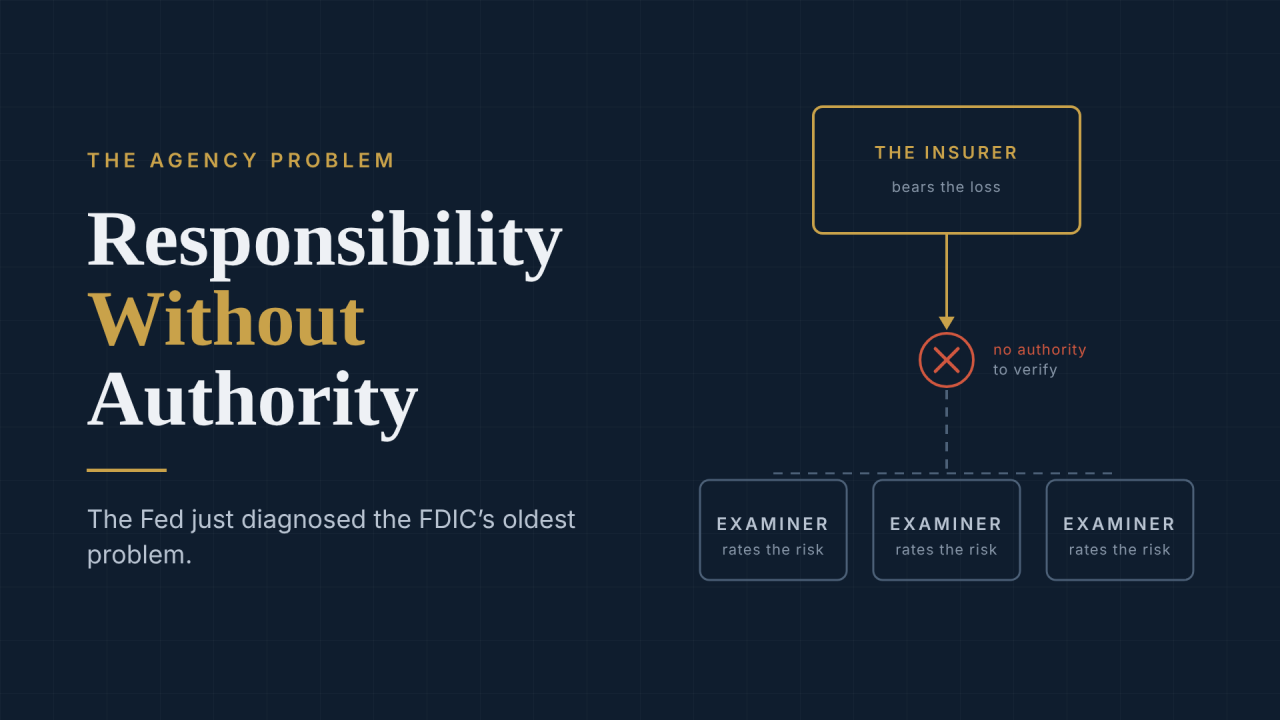
Vice Chair Bowman’s reorganization fixes an agency problem inside one institution. The FDIC has lived with a worse version for decades, and it’s time to fix it.
On October 6, Federal Reserve Vice Chair for Supervision Michelle Bowman announced that the Fed will consolidate bank supervision from twelve Reserve Bank districts into five regions, each run by a single leader accountable for all supervisory activity. Her explanation is telling:
“The execution of Federal Reserve supervision is the responsibility of the vice chair for supervision, but it is conducted by the Reserve Banks. As the review noted, for decades that structure has disincentivized a critical link between responsibility and accountability and has been further complicated by a complex web of dozens of committees, resulting in dysfunction when critical decisions are most needed.”
That is a textbook description of a principal-agent problem, and it’s refreshing to hear a sitting supervisor say it out loud.
What Bowman is describing
An agency problem exists whenever the party responsible for an outcome (the principal) depends on another party to do the work (the agent), and the agent’s incentives, information, or chain of command don’t line up with the principal’s. In the Fed’s case, the Vice Chair for Supervision answers for supervisory outcomes, but the examiners work for Reserve Banks with their own presidents, boards, budgets, cultures, and career ladders. Decisions get routed through dozens of committees, which is another way of saying that no one in particular makes them. When Silicon Valley Bank’s interest rate and liquidity risks needed someone to act, responsibility sat in Washington while execution sat in San Francisco, and the gap between the two failed to respond to the obvious decline in the condition of the bank.
Bowman’s fix is sensible: shorten the chain of command, put one accountable person over each region, and align the regions with state boundaries so the Fed coordinates more easily with state supervisors. The Fed can do this because its principal and its agents live under one roof. It’s an org chart problem, and org charts can be redrawn.
The FDIC has always had this problem, and it can’t redraw its way out
The FDIC bears the residual risk of every insured bank in the country. When a bank fails, the Deposit Insurance Fund absorbs the loss. Yet for the largest share of the industry’s deposits, the FDIC is not the primary supervisor. The OCC and the Fed are. They examine, they rate, they decide what rises to a Matter Requiring Attention, and they decide when to escalate. The FDIC bears the loss; but someone else manages the exposure.
This is why the FDIC’s agency problem is harder to fix than the Fed’s. Its agents are independent agencies with their own funding models and their own incentives. The OCC is funded by assessments tied to the size of the banks it charters, which means losing a charter to another regulator directly shrinks its budget. Chartering authorities end up competing, in part, on laxity. This is not just theory. Gary Whalen’s 2002 OCC working paper found that riskier national banks with worse supervisory ratings were more likely to flip to a state charter, and Countrywide’s move from a national bank charter to a thrift charter is the case study everyone remembers. For these reasons, solving the agency issue is more important than the FDIC’s primary supervisory authority over state non-member banks (an expensive, misaligned duty of the FDIC), and the FDIC should be willing to trade it for genuine backup authority.
Backup authority: The FDIC’s paper tiger
The FDIC does have backup examination authority on paper. Section 10(b)(3) of the Federal Deposit Insurance Act (12 U.S.C. 1820(b)(3)) empowers FDIC examiners to make a special examination of any insured depository institution whenever the FDIC’s Board of Directors determines one is necessary to determine the institution’s condition for insurance purposes. In practice, that authority has been exercised under negotiated interagency agreements: first a 2002 agreement, then the Interagency Memorandum of Understanding on Special Examinations, which the FDIC Board approved in July 2010 after the FDIC and Treasury Inspectors General faulted the FDIC for not using its backup authority effectively in the Washington Mutual failure. The MOU defines when the FDIC may conduct special examinations and requires it to give the primary regulator notice of its plans. At the meeting where it was approved, the sitting Comptroller warned against creating “supervision by committee,” indicating his resistance to free exercise of backup authority.
History follows a familiar cycle: backup authority was granted in 1983 after costly failures the FDIC hadn’t seen coming, tempered in 1993 by requiring board approval before FDIC examiners could enter a national bank or thrift, and rebuilt in 2010 after WaMu. It expands after a crisis and contracts when memories fade. Meanwhile, the head of the OCC sits on the FDIC’s board by statute. A backup supervisor that needs the cooperation of the supervisor it is backing up is not real backup authority. It’s a guest. An insurer that cannot freely inspect the risks it underwrites isn’t really underwriting; it’s spectating.
The new OCC-FDIC rule raises the stakes
The OCC and FDIC’s recently finalized rule defining “unsafe or unsound practice” and narrowing the standard for MRAs is, in my view, directionally right. Focusing supervision on material financial risk rather than process and documentation is overdue. But a feature of the rule makes real backup authority more important, not less.
The rule rests heavily on examiner judgment. The agencies explicitly declined to quantify “likely” or “material,” choosing instead to require that determinations rest on objective facts and sound reasoning. That’s defensible. But a framework built on judgment needs someone positioned to check the judgment.
What real backup authority looks like
If we take Bowman’s diagnosis seriously and apply it to deposit insurance, the FDIC needs tools to verify its agents’ work without asking their permission:
- Audit authority over examinations. The FDIC should be able to review the procedures and conclusions of other agencies’ exams, much as the PCAOB inspects the work of public accounting firms.
- The right to accompany any exam of any insured institution when it sees fit.
- Independent horizontal examinations. The FDIC should be able to run issue-based reviews across groups of banks when it sees a risk building in the sector, without needing a primary regulator’s sign-off.
- Control over offsite data. Greater authority over the content of Call Reports and FR Y-9C filings, and unfettered access to everything the primary supervisors collect. The current FFIEC process is far too slow to respond to emerging risk.
- A board that can act as principal. The FDIC’s board should be composed of people qualified in risk management, actuarial science, and bank operations, not controlled by representatives of the agencies whose work the FDIC is supposed to check.
The bottom line
Bowman is right that responsibility without accountability produces dysfunction “when critical decisions are most needed.” For the Fed, closing that gap is an internal reorganization, and I hope it works. For the FDIC, the gap is structural and statutory. No amount of reorganizing inside the deposit insurer gives it authority over examinations it doesn’t conduct.
Until the agency that pays for supervisory failure has the power to verify supervisory work, the next post-mortem will read like the last ones. We’ll round up the usual suspects, cite staffing and tailoring and culture, and miss the design flaw that sits underneath all of them.

Leave a Reply